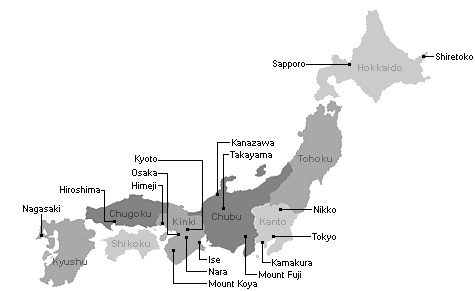
GeographyAn archipelago in the Pacific, Japan is separated from the east coast of Asia by the Sea of Japan. It is approximately the size of Montana. Japan's four main islands are Honshu, Hokkaido, Kyushu, and Shikoku. The Ryukyu chain to the southwest was U.S.-occupied from 1945 to 1972, when it reverted to Japanese control, and the Kurils to the northeast are Russian-occupied.
 Government
Constitutional monarchy with a parliamentary government.
HistoryLegend attributes the creation of Japan to the sun goddess, from whom the emperors were descended. The first of them was Jimmu, supposed to have ascended the throne in 660 B.C., a tradition that constituted official doctrine until 1945.
Recorded Japanese history begins in approximately A.D. 400, when the Yamato clan, eventually based in Kyoto, managed to gain control of other family groups in central and western Japan. Contact with Korea introduced Buddhism to Japan at about this time. Through the 700s Japan was much influenced by China, and the Yamato clan set up an imperial court similar to that of China. In the ensuing centuries, the authority of the imperial court was undermined as powerful gentry families vied for control.
At the same time, warrior clans were rising to prominence as a distinct class known as samurai. In 1192, the Minamoto clan set up a military government under their leader, Yoritomo. He was designated shogun (military dictator). For the following 700 years, shoguns from a succession of clans ruled in Japan, while the imperial court existed in relative obscurity.
First contact with the West came in about 1542, when a Portuguese ship off course arrived in Japanese waters. Portuguese traders, Jesuit missionaries, and Spanish, Dutch, and English traders followed. Suspicious of Christianity and of Portuguese support of a local Japanese revolt, the shoguns of the Tokugawa period (1603–1867) prohibited all trade with foreign countries; only a Dutch trading post at Nagasaki was permitted. Western attempts to renew trading relations failed until 1853, when Commodore Matthew Perry sailed an American fleet into Tokyo Bay. Trade with the West was forced upon Japan under terms less than favorable to the Japanese. Strife caused by these actions brought down the feudal world of the shoguns. In 1868, the emperor Meiji came to the throne, and the shogun system was abolished.
Japan quickly made the transition from a medieval to a modern power. An imperial army was established with conscription, and parliamentary government was formed in 1889. The Japanese began to take steps to extend their empire. After a brief war with China in 1894–1895, Japan acquired Formosa (Taiwan), the Pescadores Islands, and part of southern Manchuria. China also recognized the independence of Korea (Chosen), which Japan later annexed (1910).
In 1904–1905, Japan defeated Russia in the Russo-Japanese War, gaining the territory of southern Sakhalin (Karafuto) and Russia's port and rail rights in Manchuria. In World War I, Japan seized Germany's Pacific islands and leased areas in China. The Treaty of Versailles then awarded Japan a mandate over the islands.
At the Washington Conference of 1921–1922, Japan agreed to respect Chinese national integrity, but, in 1931, it invaded Manchuria. The following year, Japan set up this area as a puppet state, “Manchukuo,” under Emperor Henry Pu-Yi, the last of China's Manchu dynasty. On Nov. 25, 1936, Japan joined the Axis. The invasion of China came the next year, followed by the Pearl Harbor attack on the U.S. on Dec. 7, 1941. Japan won its first military engagements during the war, extending its power over a vast area of the Pacific. Yet, after 1942, the Japanese were forced to retreat, island by island, to their own country. The dropping of atomic bombs on the cities of Hiroshima and Nagasaki in 1945 by the United States finally brought the government to admit defeat. Japan surrendered formally on Sept. 2, 1945, aboard the battleship Missouri in Tokyo Bay. Southern Sakhalin and the Kuril Islands reverted to the USSR, and Formosa (Taiwan) and Manchuria to China. The Pacific islands remained under U.S. occupation.
Gen. Douglas MacArthur was appointed supreme commander of the U.S. occupation of postwar Japan (1945–1952). In 1947, a new constitution took effect. The emperor became largely a symbolic head of state. The U.S. and Japan signed a security treaty in 1951, allowing for U.S. troops to be stationed in Japan. In 1952, Japan regained full sovereignty, and, in 1972, the U.S. returned to Japan the Ryuku Islands, including Okinawa.
Japan's postwar economic recovery was nothing short of remarkable. New technologies and manufacturing were undertaken with great success. A shrewd trade policy gave Japan larger shares in many Western markets, an imbalance that caused some tensions with the U.S. The close involvement of Japanese government in the country's banking and industry produced accusations of protectionism. Yet economic growth continued through the 1970s and 1980s, eventually making Japan the world's second-largest economy (after the U.S.).
During the 1990s, Japan suffered an economic downturn prompted by scandals involving government officials, bankers, and leaders of industry. Japan succumbed to the Asian economic crisis in 1998, experiencing its worst recession since World War II. These setbacks led to the resignation of Prime Minister Ryutaro Hashimoto in July 1998. He was replaced by Keizo Obuchi. In 1999, Japan seemed to make slight progress in an economic recovery. Prime Minister Obuchi died of a stroke in May 2000 and was succeeded by Yoshiro Mori, whose administration was dogged by scandal and blunders from the outset.
Despite attempts to revive the economy, fears that Japan would slide back into recession increased in early 2001. The embattled Mori resigned in April 2001 and was replaced by Liberal Democrat Junichiro Koizumi—the country's 11th prime minister in 13 years. Koizumi enjoyed fleeting popularity; after two years in office the economy remained in a slump and his attempts at reform were thwarted.
At an unprecedented summit meeting in North Korea in Sept. 2002, President Kim Jong Il apologized to Koizumi for North Korea's kidnapping of Japanese citizens during the 1970s and 1980s, and Koizumi pledged a generous aid package—both significant steps toward normalizing relations.

Koizumi was overwhelmingly reelected in Sept. 2003 and promised to push ahead with tough economic reforms.
In April 2005, China protested the publication of Japanese textbooks that whitewashed the atrocities committed by Japan during World War II. Prime Minister Koizumi apologized for Japan's abuses, admitting that “Japan, through its colonial rule and aggression, caused tremendous damage and suffering.”
In Aug. 2005, Koizumi called for early elections, when the upper house of parliament rejected his proposal to privatize the postal service—a reform he has long advocated. In addition to delivering mail, Japan's postal service also functions as a savings bank and has about $3 trillion in assets. Koizumi won a landslide victory in September, with his Liberal Democrat Party securing its biggest majority since 1986.
Princesss Kiko gave birth to a boy in September. The child's birth spares Japan a controversial debate over whether women should be allowed to ascend to the throne. The child is third in line to become emperor, behind Crown Prince Naruhito, who has one daughter, and the baby's father, Prince Akishino, who has two daughters.
In September, a week after becoming leader of the ruling Liberal Democratic Party, Shinzo Abe succeeded Junichiro Koizumi as prime minister. He promptly assembled a conservative cabinet and said he hoped to increase Japan's influence on global issues. Early into his term, Abe focused on nationalist issues, giving the military a more prominent role and paving the way to amend the country's pacifist constitution. He suffered a stunning blow in July 2007 parliamentary elections, however, when his Liberal Democratic Party lost control of the upper house to the opposition Democratic Party.
Abe faced international criticism in early 2007 for refusing to acknowledge the military role in forcing as many as 200,000 Japanese women, known as comfort women, to provide sex to soldiers during World War II. In March, Abe did apologize to the women, but maintained his denial that the military was involved. "I express my sympathy for the hardships they suffered and offer my apology for the situation they found themselves in," he said.
A 6.8 magnitude earthquake struck in northwest Japan in July 2007, killing 10 people and injuring more than 900. The tremor caused skyscrapers in Tokyo to sway for almost a minute, buckled roads and bridges, and damaged a nuclear power plant. About 315 gallons of radioactive water leaked into the Sea of Japan.
Prime Minister Abe abruptly announced his resignation in September just days into the parliamentary session, during which he stated his controversial plan to extend Japan's participation in a U.S.-led naval mission in Afghanistan. The move followed a string of scandals and the stunning defeat of his Liberal Democratic Party in July's parliamentary elections. The Libeal Democratic Party elected Yasuo Fukuda to succeed Abe. Fukuda, a veteran lawmaker, was elected to Parliament in 1990 and held the post as chief cabinet secretary under Prime Minister Junichiro Koizumi.